


Ohio Lawn Fertilizer Schedule: What to Apply Each Season
A practical year-round fertilizer schedule for Ohio cool-season lawns, with a close look at why early and late fall feedings do the most good.

When Should I Winterize My Sprinkler System in Ohio?
Most Northwest Ohio irrigation systems need a blowout between mid October and early November. Here is how to time it, what the process involves, and what freezing does if you wait too long.

Techo-Bloc Blu 60 Pavers: What an Installer Wants You to Know
Blu 60 is a 60 mm patio slab, not a driveway paver. What an installer wants you to know about finishes, the lifetime warranty and what moves the price.

Fall Landscape Installation in Wauseon: Rooting Right
Plan grade, hardscape, mature plant spacing, watering, and winter checks before a fall landscape installation in Wauseon.

Paver Sealing in Sylvania, Ohio: A Fall Readiness Guide
Use this Sylvania fall readiness guide to inspect, repair, clean, dry, test, and properly time a paver sealing project before Northwest Ohio winter weather.

Lawn Overseeding in Toledo: A Late-Summer Guide
Lawn overseeding can rebuild thin Toledo turf before fall. Learn how timing, preparation, watering, and aeration shape a thicker, more even lawn this fall.

Core Aeration in Perrysburg, OH: What the Process Actually Involves and When to Schedule It
We work across Northwest Ohio from our base in Wauseon, OH, where the region's heavy clay soils and wet spring cycles create lawn conditions that demand attention well before fall arrives. Our earlier post on Maumee River Valley soil and climate looked at how regional geology shapes landscape decisions broadly. What it did not address is something far more specific: what happens beneath the surface of a Perrysburg lawn after a full season of foot traffic, heat, and summer rainfall, and why late August is exactly when intervention matters most. Core aeration Perrysburg OH is one of the most time-sensitive services we provide each year. Core aeration in Perrysburg, OH involves mechanically removing small plugs of soil from a lawn to relieve compaction, improve root-zone oxygen levels, and allow water and nutrients to penetrate deeper into the ground. The process is performed with a hollow-tine aerator, takes one to two hours for most residential properties, and is most effective when scheduled in late August or early September for cool-season grass. Key Takeaways Late August through mid-September is the optimal window for core aeration in Perrysburg because cool-season grasses are entering their most active recovery period. Perrysburg's heavy clay-dominant soil compacts more aggressively than sandy or loam-based soils, making aeration more than routine maintenance. Hollow-tine aeration physically removes soil cores rather than simply poking holes, which is the only method that meaningfully reduces compaction. Aeration is most productive when paired with overseeding and fertilization, which can be scheduled in the same visit. Soil plugs left on the surface after aeration break down naturally within one to two weeks and should not be removed. Why Perrysburg Soil Makes Core Aeration More Than a Routine Task Perrysburg sits on what was historically the lakebed of ancient Lake Erie, and that geological history left behind a soil profile that is dense, fine-grained, and prone to compaction under almost any kind of pressure. Clay-heavy soil particles pack together tightly, and once compaction sets in, it does not loosen on its own. Water pools on the surface instead of moving through the profile. Grass roots, unable to push through the compressed layers, stay shallow and weak. By the time late summer arrives, a full season of mowing, kids, pets, and even routine irrigation has made the problem significantly worse. This is different from the conditions you might find in a sandier soil region. In those areas, compaction is slower to develop and somewhat self-correcting. In Perrysburg, and throughout much of the Maumee River corridor, compaction is a predictable annual event. That is why we treat core aeration Perrysburg OH as a necessary part of the fall maintenance cycle rather than something to consider only when a lawn looks visibly stressed. By the time the lawn looks stressed, the root system has already been compromised for weeks. If you have read our related post on weed control in Perrysburg, you already know that clay soil also creates conditions where weed pressure increases. Compaction and weed encroachment are [...]

Stump Grinding in Sylvania, OH: Why August Is the Right Month to Act
A lot of homeowners in Wauseon, OH start thinking about artificial turf in late summer, once they have watched another dry July turn their natural grass patchy and uneven. Wauseon sits in Fulton County, where clay-heavy soils hold moisture unevenly and late-summer heat accelerates surface deterioration faster than many homeowners anticipate. They walk the yard, they measure the space, and then they spot it: a stump sitting right where the new turf would go, or directly in the path of a planned patio expansion. That one discovery shifts the whole project. Suddenly the conversation is not just about turf or pavers, it is about stump grinding in Sylvania, OH, and whether there is still enough of the season left to get it done before fall installation work begins. Stump grinding in Sylvania, OH involves using a rotating cutting wheel to mechanically chip a tree stump down below grade, typically 6 to 12 inches deep, so the ground above can be graded, filled, and built upon. The process does not remove the root system entirely, but it eliminates the above-ground and near-surface obstruction that blocks hardscape and turf installations. Most residential stumps are completed in a single visit. For homeowners planning a patio, walkway, or turf installation this fall, addressing the stump now is the step that keeps the rest of the project on schedule. Key Takeaways Stump grinding removes the above-ground obstruction and grinds the stump below grade so hardscape and turf work can proceed on a clean surface. August is one of the strongest months for stump grinding because ground conditions are firm, schedules are still open before the fall rush, and remaining root material has time to begin breaking down before winter. Homeowners planning artificial turf, patios, or walkways in the Sylvania area should address stumps before those installations begin, not after. Rock Solid Landscape serves Sylvania and the surrounding northwest Ohio region, including Wauseon, Maumee, Perrysburg, and Toledo. Pricing depends on stump size, location, and site conditions; a custom estimate is the only accurate way to understand the cost for your property. Why a Stump Becomes Visible When You Start Planning Something Else This is one of the most common patterns we see. A homeowner is not thinking about tree removal at all. They are planning an outdoor design project, maybe a patio, a fire pit area, or a turf installation, and the stump only becomes a problem once they start measuring and laying out the space. In the Wauseon area, many older properties along County Road J and the surrounding rural routes have mature trees that were taken down years ago but never fully cleared. The stump was left because it was not in the way at the time. Now it is. The same thing happens with artificial turf projects specifically. Artificial turf requires a stable, properly graded base. A stump, even a low one, creates an uneven surface that cannot be compacted correctly. If it is left in place and the turf is installed around [...]

Lawn Fertilization in Toledo, OH: Questions Homeowners Actually Ask
If you have ever dug into a Wauseon, OH yard and pulled up a clump of heavy, gray-brown clay, you already know that northwest Ohio soil does not behave like the loose, loamy stuff in gardening magazines. That same dense clay runs through much of the greater Toledo area, and it has a direct effect on how your lawn absorbs nutrients, handles heat stress, and responds to fertilization. Getting fertilization right here means understanding what the ground is actually doing, not just following a generic schedule. Lawn fertilization toledo oh involves applying the right nutrient blend at the right time to support turf health through the region's clay-heavy soil conditions and hot, humid summers. For most Toledo-area lawns, a structured program includes applications in early spring, late spring, summer, and fall, with product selection adjusted for soil pH and grass type. A professional service ensures timing and rates match local conditions rather than a one-size-fits-all calendar. Key Takeaways Northwest Ohio's clay soil affects nutrient absorption, so fertilization programs here require different timing and product choices than national guidelines suggest. Summer fertilization in the Toledo area should use slow-release formulas to avoid burning heat-stressed turf. Soil pH in the Toledo region often runs slightly acidic, which can block nutrient uptake even when fertilizer is applied correctly. Combining fertilization with weed control and core aeration produces better long-term results than fertilization alone. Rock Solid Landscape serves Wauseon and the broader Toledo area, including Toledo, Maumee, Perrysburg, and Sylvania. Why does lawn fertilization toledo oh need to account for clay soil? Clay soil holds nutrients differently than sandy or loam soil. It can actually trap certain nutrients like potassium and phosphorus in ways that make them unavailable to grass roots, even when the fertilizer is sitting right there in the ground. In the Toledo area, this means a standard box-store fertilizer applied without a soil test often produces disappointing results, not because the product failed, but because the soil chemistry blocked it. Our team accounts for this by adjusting product selection and application rates based on what the ground is actually doing, not what a bag label recommends. What time of year should I fertilize my lawn in the Toledo area? A complete fertilization program for northwest Ohio typically includes four applications: early spring to push green-up, late spring to strengthen roots before summer heat, a mid-summer application using slow-release nitrogen to feed without burning stressed turf, and a fall application that builds root reserves before dormancy. July is one of the trickier months because turf is already under heat and drought pressure, and the wrong product or rate can scorch a lawn fast. We time our summer applications carefully and choose formulas that release nutrients gradually so the grass gets fed without being pushed into growth it cannot sustain in the heat. Is fertilizing in July actually safe for my grass? Yes, with the right product and timing. The risk in mid-summer is applying a fast-release, high-nitrogen fertilizer during a heat wave, [...]
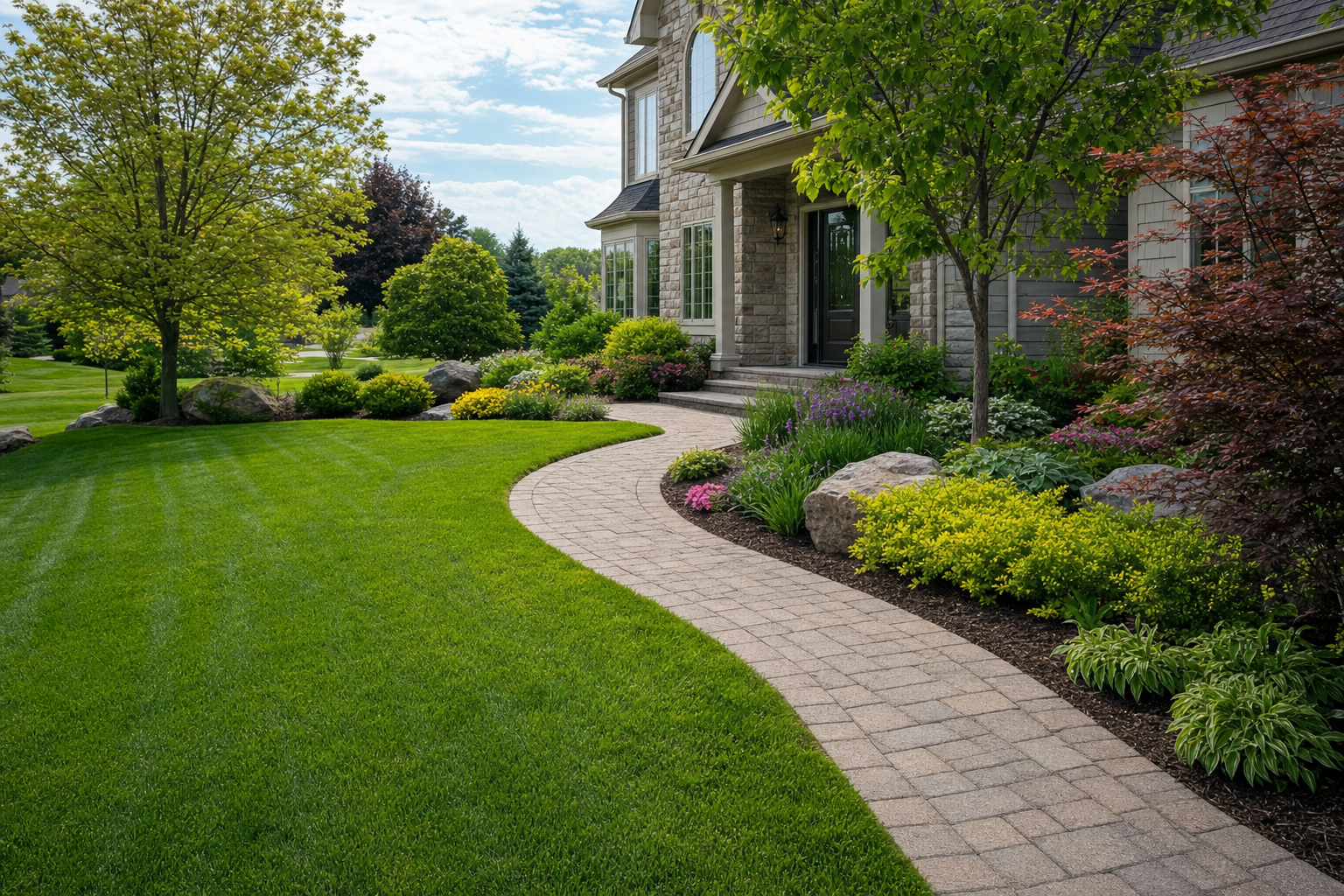
Landscape Design Renderings in Sylvania, OH
A detailed landscape rendering lets you compare patios, turf, lighting, and other features before installation begins on your Sylvania property.